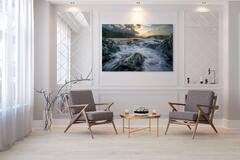
The Science Behind Why Landscape Art Makes You Feel Better
Have you ever walked into a room, noticed a beautiful landscape print on the wall, and feel your shoulders drop just a little? Maybe your breathing slows a bit? Maybe the space feels calmer, more inviting, more “you?”
That reaction isn’t just in your head. Over the past few decades, psychologists, neuroscientists, and medical researchers have been studying how nature and art affect the brain and body. The short version: surrounding yourself with thoughtful landscape art can genuinely influence your stress levels, mood, and even how focused you feel during the day.
Why Our Brains Respond So Strongly to Nature
Long before we talked about “wellness,” researchers were already noticing something simple but powerful: people feel better when they’re around nature.
One of the most famous examples comes from environmental psychologist Roger Ulrich. In 1984, he analyzed recovery records from hospital patients after surgery. Those whose windows faced trees recovered faster, needed less pain medication, and had shorter hospital stays than patients whose rooms looked out at a brick wall.
In the years since, multiple studies have backed up the idea that nature helps our nervous system shift out of stress mode. Two major theories show up again and again:
- Stress Reduction Theory suggests that humans have a built-in positive response to natural environments. Greenery, water, and open views tend to activate the “rest and digest” side of the nervous system, lowering stress and promoting recovery.
- Attention Restoration Theory, developed by researchers Rachel and Stephen Kaplan, proposes that time in nature (or even looking at images of nature) helps restore our ability to focus after long periods of mental effort. Nature offers what they call “soft fascination” — gently engaging without demanding.
More recently, a 2023 study in the Journal of Environmental Psychology found that even imagining natural scenes, (not just visiting them), led to slower heart rates and greater feelings of calm compared with imagining urban environments.
That’s the part that matters for a home or office: you may not always be able to sit by a lake in Colorado or a beach in Kauai, but your brain can still tap into some of the same restorative benefits through visual cues. Carefully chosen landscape prints act as a kind of “mental shortcut” to those environments.
Does Art Itself Really Make a Difference?
Nature is one piece of the puzzle. Art is another.
Several studies have looked at how viewing art — not just nature scenes, but art in general — affects stress and mood. One report, commissioned by the UK’s Art Fund and conducted with researchers at King’s College London, found that people who spent time with original artworks showed reduced self-reported stress and measurable drops in cortisol levels, the hormone associated with stress.
Other research and surveys on museum and gallery visitors consistently show similar themes: looking at art can make people feel calmer, more inspired, and more connected.
Put those two ideas together — nature plus art — and you get something uniquely powerful: landscape photographs that are both aesthetically pleasing and biologically “familiar” to your nervous system.
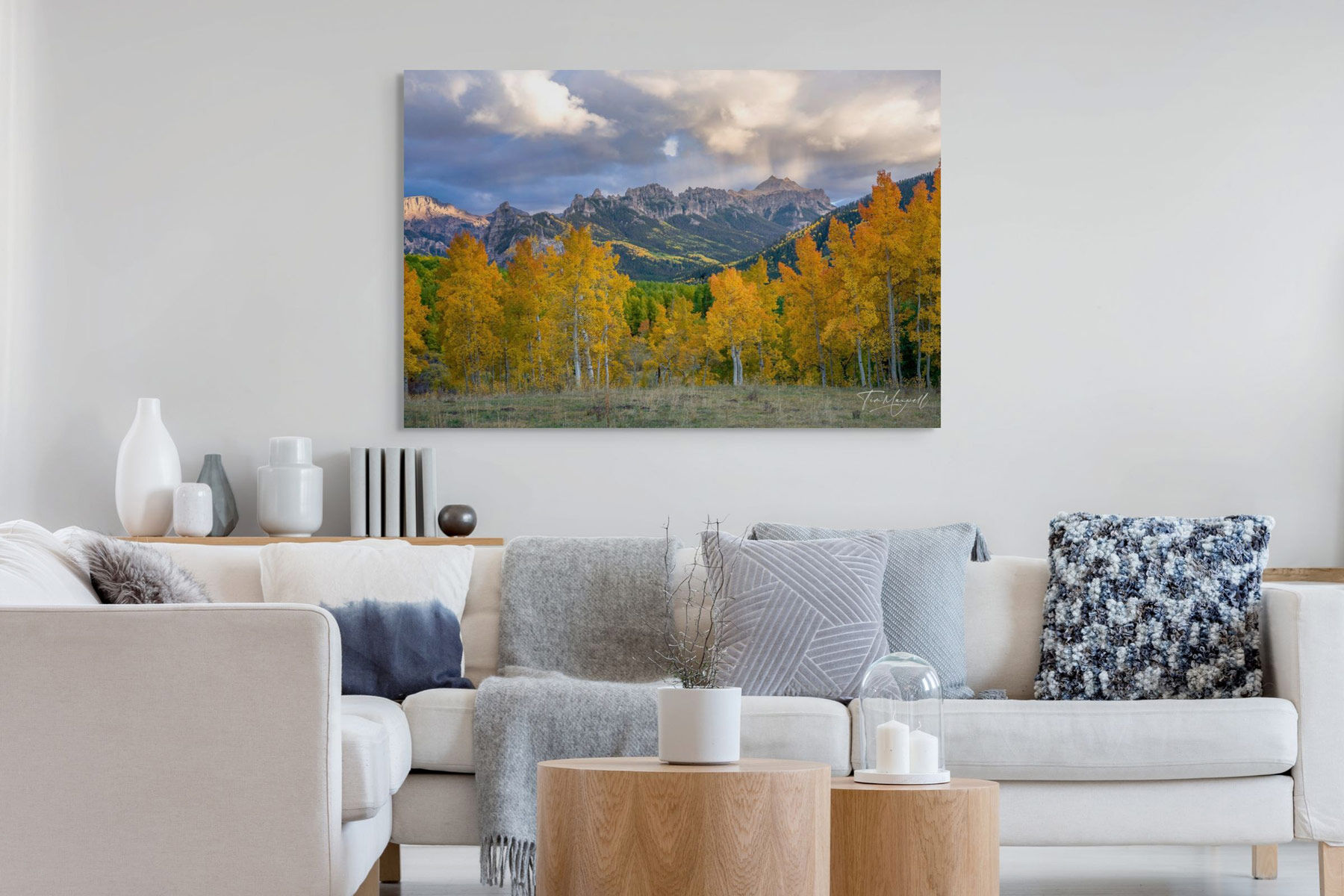
That’s why a large print of golden aspens in Colorado, a quiet bay in Kauai, or the Manhattan skyline at dusk can do more than decorate a wall. It can subtly shift how a room feels to be in, and how you feel while you’re there.
What Landscape Art Does for Everyday Spaces
From a practical, lived-in point of view, landscape art tends to help in three main ways: stress, mood, and focus.
1. Lower perceived stress
We all have days when the inbox is overflowing or the house feels chaotic. Visual reminders of calm places can act like gentle “reset buttons.” Studies on nature views, even from a window or a screen, show reductions in stress indicators such as heart rate and blood pressure, along with improved emotional recovery after a stressful task.
A thoughtfully chosen print in your living room, hallway, or bedroom becomes a visual breathing space — especially if it depicts a place you personally find soothing: mist over a canyon, the first light on a mountain ridge, or soft reflections on a still lake.

2. Better mood and sense of well-being
A growing body of research suggests that people who regularly visit galleries or surround themselves with art report higher life satisfaction and improved overall well-being.
Landscape art in particular tends to evoke feelings of awe, nostalgia, and calm. Those emotions are not just “nice to have,” they’re tied to lower rumination, greater sense of connection, and even prosocial behavior in some studies of awe and nature exposure.
In a home setting, that might look like:
- A large mountain scene in the living room that becomes a quiet focal point after a long day.
- A coastal print in the dining area that reminds you of favorite travels.
- A cityscape that captures the energy of a place you love without adding chaos to the space.
3. A nudge toward focus and clarity
Because landscape images often mirror what our brains find calming in the real world — open vistas, gentle curves, soft natural light — they can help counterbalance the constant stimulation of screens and notifications.
Attention Restoration Theory suggests that scenes with soft, natural patterns give the “focus” part of your brain a chance to rest and reset. Viewed over time, a well-placed landscape print in a home office or workspace can become a visual anchor that quietly supports concentration instead of competing with it.
If you work from home, a piece above your desk that looks out over distant peaks or a quiet coastline can subtly signal “space” and “perspective,” which is often what we’re missing in the middle of a busy day.
Why Print Quality Matters for the Experience
Not all prints are created equal, and the research actually supports paying attention to quality.
In the Art Fund / King’s College London work I mentioned previously, the stress-reducing effects were strongest when people viewed original artworks in person rather than reproductions on a screen. It goes without saying that being there in person is always better than staring at a print. That doesn’t mean prints are “lesser,” but it does suggest that depth, clarity, and presence matter.
High-end print processes like Lumachrome® TruLife® acrylic and ChromaLuxe® HD metal are designed to maximize those qualities — rich color, fine detail, and a sense of depth that makes the image feel more like a window than a poster. When you walk past a piece like that every day, the impact is different than walking past a thin, faded print that you barely notice.
This is also where thoughtful framing comes in. A well-chosen Italian wood frame (like the ones I offer from ROMA® Moulding) or clean frameless presentation helps the piece feel intentional and permanent, which can influence how your brain reads it: not as “wall filler,” but as something worth slowing down for.
Making It Personal: Choosing Art That Actually Works for You
The science is helpful, but the most important part is personal resonance. A nature scene that feels calming to one person might feel lonely or intense to someone else.
A few questions to ask yourself when choosing a piece:
- Does this image make me breathe a little deeper when I look at it?
- Could I imagine seeing this every day without getting tired of it?
- Does it remind me of a place, season, or feeling I actually enjoy?
- Does it balance the energy of the room (for example, adding calm to a busy space or warmth to a cool, minimal room)?
If the answer is yes to most of those, you’re likely choosing art that won’t just look good in a photograph of your room, but will actually feel good to live with.
This is one of the reasons I structure my collections around real places — Colorado, Washington, Hawaii, New York, New England — rather than abstract themes alone. It allows you to gravitate toward regions and moods that already mean something to you, whether that’s crisp mountain air, mist over the ocean, or the glow of a city at night.

Bringing It All Together
To sum up what the research and real-world experience both suggest:
- Nature helps your nervous system shift out of stress.
- Art gives you a way to bring that effect indoors in a lasting, daily way.
- High-quality, carefully chosen landscape prints can meaningfully influence how your home or office feels — calmer, more grounded, more “you.”
If you’ve been thinking about adding art to your space, it isn’t just about filling a blank wall. It’s about creating an environment that quietly supports how you want to feel: more relaxed at the end of the day, more focused while you work, or simply more connected to the places you love most.
From here, you might:
- Explore the Colorado Gallery for mountain and autumn pieces that bring the high country home.
- Visit the Coastal and Hawaii collections if you’re drawn to water, sunrise, and softer light.
- Or read more about the difference between fine art photography and everyday wall decor if you’re still deciding what belongs on your walls.
Wherever you start, the goal is simple: surround yourself with images that help you breathe a little easier when you walk into the room. If I can help you with this process in any way, please feel free to reach out!