Photo Journal - Death Valley and Three Days of Lessons in the Desert

In early March I found myself with a rare stretch of a few open days and decided it was a good time for a short photography trip. Normally when I travel for photography, it’s with a group. Someone else has already scouted the locations, the schedule is dialed in, and all I have to do is show up, point my camera in roughly the same direction as everyone else, and try not to embarrass myself.
This time, however, I had to decide where to go on my own. That turned out to be a surprisingly difficult problem. For several days I bounced between ideas. The Oregon Coast was tempting, but I'm planning on going there in the fall. The California Coast and Big Sur crossed my mind more than once, but one of the epic waterfall viewpoints is currently closed. I even briefly considered Aspen so I could finally photograph Maroon Bells, which somehow still hasn’t happened despite living in Colorado.
Eventually, after exhaustive research, I landed on Death Valley National Park.
If I’m being honest, the desert wasn’t exactly calling my name. I tend to prefer mountains, forests, and dramatic seascapes to barren wastelands, and abstract salt formations. Desert landscapes have always felt a little… minimal to me. But all of my research kept pointing back to Death Valley for portfolio-worthy material. Early March is usually a great time to visit, the weather tends to cooperate, and according to countless photos online, the composition opportunities are very good. Clean sand dunes. Endless polygon salt patterns. Massive desert vistas glowing under dramatic skies. It all looked and sounded so easy.
So I packed up the camera gear and headed for the hottest place on earth (in the summer anyway). My expectations were simple. I hoped to come home with a few strong images for the portfolio and maybe gain some confidence shooting a location entirely on my own instead of relying on a workshop. As it turns out, Death Valley had slightly different plans...
Day 1 – Sand, Footprints, and Regret
After spending a couple nights in Las Vegas (which I always enjoy), I picked up my rental car and made the two hour drive into Death Valley on Sunday afternoon. One of the first things I noticed was how different the entrance process felt compared to places like Yosemite. There was no ranger station greeting visitors, no line of cars waiting to get in. Instead, you stop at a dusty kiosk, pay the entrance fee, and leave the receipt on your dashboard. It felt strangely impersonal, like the park was operating on the honor system and no one really cared if you were there or not.
My base for the trip was The Ranch at Death Valley, which is conveniently located right inside the park. Like many hotels within or very near national parks, it offers two-star accommodations at five-star pricing. As if the $400/night pricing for the room wasn't enough, they know they have you over a barrel when it comes to food and grocery prices. You'll either pay that $5 for a candy bar, $12 for a frozen TV dinner, or drive an hour to pick one up in the next town over. Apparently the cost of transporting snacks into the desert rivals that of importing fine wine. Naturally, I had not thought to bring groceries ahead of time. Lesson learned.
After settling in and catching up on a little work, I headed out toward the Mesquite Flat Sand Dunes for sunset. This was a location I was excited about. The photos I had seen from here were stunning. Perfectly sculpted ridges in the sand leading directly toward distant mountains glowing under dramatic sunset light. The catch, according to everything I had read, was that you needed to walk out into the dunes for ten or fifteen minutes to escape the tourist footprints near the parking lot. No problem, I thought. I can handle that.
So I pulled the car into the parking area, grabbed my tripod and set off across the sand. About 30 minutes later I was still trudging along. I could no longer see the parking area, and had only a vague idea of which way it was. Each time I climbed a dune ridge, I expected to finally see that pristine stretch of untouched sand that everyone else seems to photograph here. Instead I would crest the hill, nearly collapse, and find more footprints, more tourists with seemingly unlimited energy taking selfies, and more dunes ahead.
Walking in sand is also far more exhausting than it looks. Each step sinks just enough to make you question your life choices. Climbing the dunes felt like hiking uphill through quicksand while carrying a backpack full of camera gear. Eventually, I stopped at the top of yet another ridge to catch my breath and looked around. Footprints everywhere. Ugly black sand all around. People scattered across the dunes. No obvious foreground elements other than a few half dead shrubs that looked like they had given up on life sometime in the mid-80s.
I’ll admit something here that may sound strange for someone who flew in to photograph this place. I genuinely had no idea what to shoot. The sky was completely clear, so I waited for sunset anyway. The distant mountains did catch a little bit of pink light as the sun dropped, and I took a handful of photos, but more out of obligation more than inspiration. None of them felt particularly special.

Eventually I began the slow walk back to the parking lot feeling a little discouraged. By the time I reached the car there, was enough sand in my shoes to start my own small beach, and my calves were burning like I had just completed an emergency dune fitness program. On the bright side, at least I got some exercise.
Day 2 – The Easy Shot That Wasn’t
My sunrise plan for the second morning was Zabriskie Point, which on paper sounded much simpler than wandering aimlessly through sand dunes hoping to discover an untouched masterpiece.
Zabriskie Point is one of the most famous viewpoints in Death Valley. The area is known for its maze of golden badlands, where sharp ridges and eroded hills catch the low morning light and create dramatic patterns of highlights and shadows. The most recognizable feature from the overlook is Manly Beacon, a striking triangular peak that rises from the surrounding ridges. It was named after William Manly, a pioneer who helped rescue a group of stranded settlers from Death Valley during the California Gold Rush in 1849. Today it serves as the visual centerpiece for countless sunrise photographs taken from this viewpoint.

The best part of shooting here? The main overlook is only a short walk from the parking lot. No sand slogging required. After the previous evening’s dune expedition, this sounded wonderful.
I arrived about an hour before sunrise and found a handful of other photographers were setting up. A small group of three appeared to be part of a workshop, and over the next half hour, another 40-50 tourists filtered in with phones and small cameras. It quickly became clear that sunrise at Zabriskie Point is not exactly a hidden secret.
Still, the composition itself was refreshingly straightforward. Manly Beacon sits prominently among a series of layered ridges, and when the sun rises behind you, the low light sweeps across the badlands and brings out every wrinkle and texture in the landscape. I set up my tripod right in the middle of the viewing area and framed the scene, zooming in to emphasize the shapes and shadows around the beacon.
Then, just as the sky started to brighten and the crowd of photographers dialed in their settings, a few tourists decided it was the perfect moment to wander down the path directly into the foreground of every tripod in the area. At first it was only a couple people. Then a few more followed. Within minutes, there were a dozen people scattered across the rocks below the viewpoint, all standing exactly where every photographer hoped no one would stand. Phones held high, backs turned toward the view, happily taking selfies while 20 cameras pointed directly at them.
No one said anything, but I did overhear the workshop leader next to me quietly remark, “There’s always somebody.”
Eventually I realized that zooming in tight enough to avoid them would ruin the composition. Cropping them out later would mean losing the interesting foreground shapes entirely. So I did the only logical thing. I grabbed my tripod, walked down the path, and joined them. Ironically, once I was down there, the compositions were actually better. Being closer to the ridges gave the scene more depth, and I was able to isolate some interesting shapes in the badlands that weren’t visible from the main overlook.
When the sun finally crested the horizon, it cast long shadows across the ridges and lit the hills with warm golden light. It wasn’t the dramatic sky I had hoped for, but the textures in the terrain made up for it. For the first time on the trip, I felt like I had actually made a few images worth keeping.

After sunrise I packed up my gear and spent the rest of the morning exploring some other locations on my list.
One of the first stops was the Devil’s Golf Course. The name alone made it sound like something worth seeing. The area is known for its jagged salt formations that cover the ground like a field of broken crystals. The story goes that the terrain is so rough that only the devil himself could play golf there.
When I followed the GPS down a long dirt road and arrived at the spot, however, it looked mostly like a crusty salt field with no obvious compositions. I sat there for a moment considering whether it was worth getting out and wandering around with the camera. In the end, I decided it probably wasn’t going to produce anything portfolio worthy and drove on.
From there I continued along Artist’s Drive, a scenic one-way road that winds through colorful volcanic hills. The most famous stop along this route is Artist’s Palette, where mineral deposits in the rock create patches of green, pink, yellow, and purple across the slopes. The hills were definitely colorful, though not quite as vibrant as some of the photos I had seen online. Wildflowers were also beginning to bloom across the desert floor, though instead of covering the ground in huge fields, they appeared scattered in small clusters here and there. The late afternoon light was harsh, and I struggled to find a composition that really worked.
At one point my GPS calmly informed me that I had “arrived” at Artist’s Palette. The problem was that the road clearly continued ahead while the map on my phone simply stopped. It was seemingly just a random spot on the road. With no cell service, I briefly wondered if I had somehow driven myself into a dead end in the middle of the desert. Fortunately the road eventually looped back to the main highway exactly as it was supposed to, but it was definitely nervous time for a bit. This is not the type of place you want to get lost.
Later that afternoon I drove out to scout Badwater Basin for the next morning’s sunrise. Badwater Basin is the lowest point in North America, sitting 282 feet below sea level. It’s famous among photographers for the polygon shaped salt formations that stretch across the flats. Again, you apparently just have to walk out farther than the average tourists are willing to go to find clean, undisturbed patterns.
So I joined the throngs of people walking across the flats, with the plan to keep walking as long as it took to leave them behind. As I walked, the path got soggier until I came to a spot in the basin that was covered with shallow standing water. It looked almost like a small lake from a distance. When I asked another photographer about it, he told me the last storm had been months earlier and the water had simply remained. Great. So much for the polygon patterns I had imagined. The one saving grace was that the water created some interesting reflections of the surrounding mountains. I made a mental note to come back before sunrise and see if the wind stayed calm.
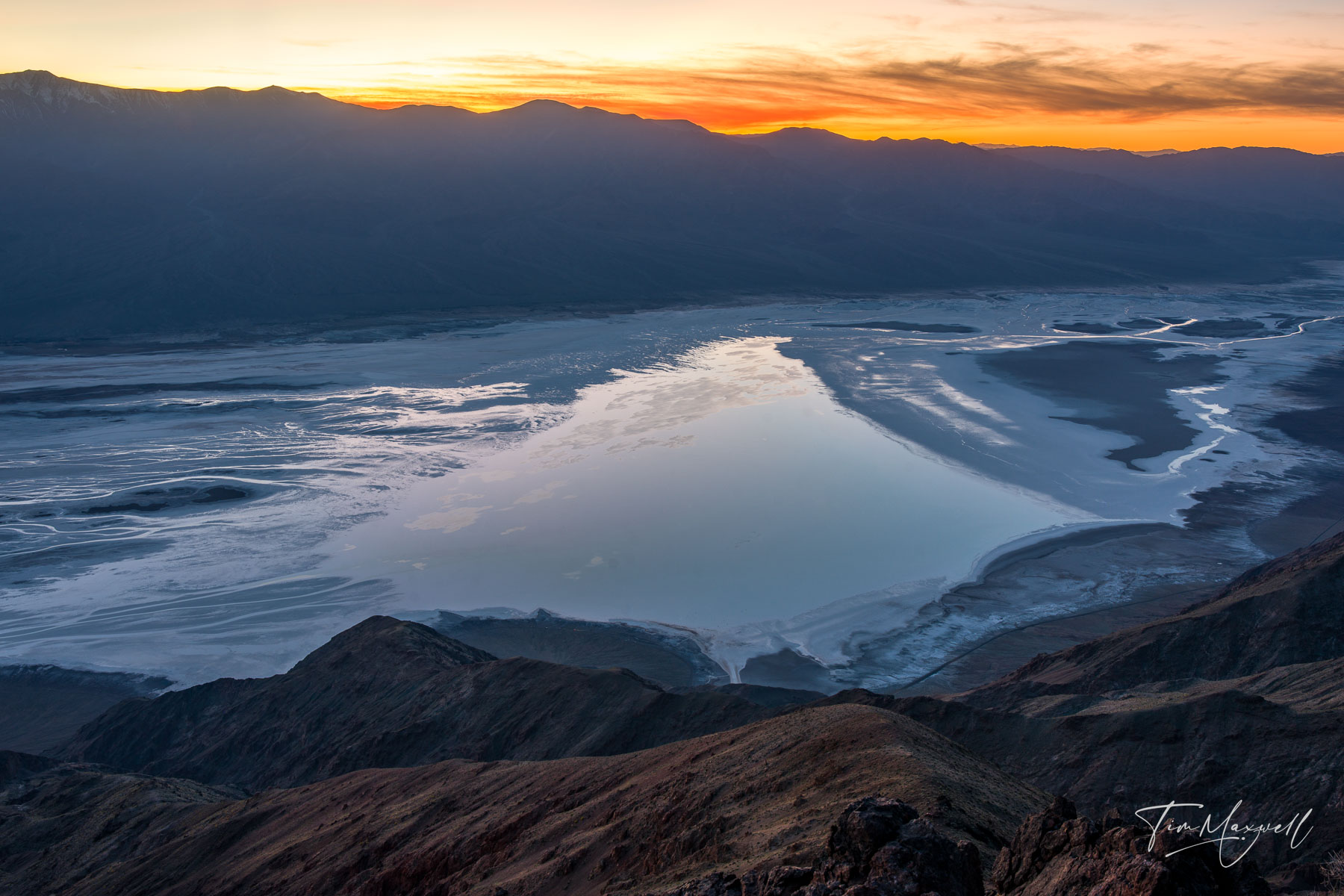
I left and then headed up to Dante’s View for sunset, which sits high above Death Valley on the crest of the Black Mountains. From this overlook, you can see across the entire Badwater Basin toward the Panamint Range and Telescope Peak far in the distance. I'd estimate that about a hundred people were scattered along the various ridges waiting for sunset. I wandered away from the main viewpoint and set up on a nearby peak with a few other photographers and hikers.
For the first time on the trip, a few clouds finally appeared. The sunset produced some beautiful color across the sky. Unfortunately a thick haze hung over the valley floor, softening the distant mountains and muting much of the scene. It was still a beautiful place to watch the sun go down, but once again, the photos weren’t quite what I had hoped for.
Day 3 – Reflections, Haze, and the End of My Shoes
My final morning in Death Valley started early. I left the hotel around 5:50 a.m. and drove back toward Badwater Basin in the dark. The roads were empty, the temperature was surprisingly warm even before sunrise, and the sky was completely clear once again. For that 30 minute drive, I felt like the only one in the world.
When I arrived, there were just a few people and a couple of photographers out on the salt flats. Maybe five or so. Compared to the crowds at Zabriskie Point the morning before, it felt almost peaceful.
The walk out onto the flats was one of the more memorable moments of the trip for me. The air was calm and smelled fresh, the ground stretched out endlessly in front of me, and the silence was almost unsettling in its completeness. No wind. No birds. No distant traffic. Just the quiet crunch of salt under my shoes as I walked farther out toward the water I had scouted the day before.
It took about 10 minutes to reach the same shallow pools of standing water I had seen the previous afternoon. The surface was perfectly still, creating a mirror-like reflection of the mountains in the distance. One of those mountains is Telescope Peak, the highest point in Death Valley National Park. Rising over 11,000 feet above sea level, it towers above the basin below. What makes it even more surreal is that while the valley floor was already pushing into the mid 70s, Telescope Peak still held a noticeable layer of snow near its summit. Combine that with the fact that the wet salt all around looks like snow, and you've got yourself a pretty surreal experience in the desert.
The reflections in the water were beautiful, and for a brief moment I thought maybe this would be the shot that salvaged the trip. The light slowly crept down the slopes of the mountains as the sun rose behind me, casting a soft pink glow across the peaks. Unfortunately the same haze that had plagued Dante’s View the night before was still lingering in the valley. Even as the mountains lit up with color, the distant ridges looked muted and slightly washed out. It was nice light to be sure, but not quite the dramatic scene I had hoped for.
Still, I took my time working different compositions. The reflections were clean, the water was calm, and the quiet of the place made it easy to forget about everything else for a while.
Eventually the sun climbed higher and the light started to flatten out. The small group of photographers scattered across the flats slowly began packing up and heading back toward the boardwalk. I took a few final frames and started the long walk back. That’s when I discovered that what looked like solid salt crust was actually a thin layer floating on top of mud. One step forward and my foot sank straight down about six inches into the muck. When I yanked my leg back up, my shoe decided to stay behind.
For a moment I just stood there trying to balance on one foot in the middle of the salt flats wondering how exactly this had become part of my morning photography routine. Eventually I reached down and tried to pull the shoe free. It resisted with surprising determination before finally releasing with a loud, deeply satisfying squelch that echoed across the otherwise silent basin. By the time I got it out, the shoe was completely coated in salty mud. I decided it was not salvageable. When I reached the car, both shoes were essentially finished, and they were unceremoniously retired into the nearest trash bin a little while later.
At least they had gone out doing something memorable.

Conclusion – When the Conditions Don’t Show Up
In the end, the trip didn’t quite produce the results I had hoped for. I came home with around 300 photos from the three days. A few from Zabriskie Point and Dante’s View are decent enough, but none of them really stood out as portfolio pieces. The clean dunes I had imagined were covered in footprints. The beautiful salt polygons were hidden under standing water. And the haze muted several otherwise promising scenes.
It would be easy to call the trip a failure. But in reality, it was probably a fairly accurate introduction to what landscape photography is actually like. The photos we see online from places like Death Valley represent rare moments when everything aligns. Dramatic skies. Clean foregrounds. Perfect light. Those moments exist, but they don’t happen every day. Sometimes you do the research, plan the locations, wake up before sunrise, hike across dunes, scout salt flats, and still walk away without the shot you had in mind. That’s just part of the process.
The trip also taught me something else about myself. As much as I thought I wanted to prove I could do this entirely on my own, I realized I genuinely enjoy workshops more than I expected, and not just because the hard scouting work is done for you. Being out in remote places with other photographers, learning from them, sharing the experience, and not feeling completely alone in the middle of nowhere is something I appreciate more now.
Walking back to the car at Dante’s View in complete darkness the night before, it did cross my mind how easy it would be for someone to walk up behind you, steal your gear, your car keys, and leave you stranded on top of a mountain with no cell service. Probably an overly paranoid thought, but still...
In the end, the trip gave me a little more experience, a few decent photos, and a healthy reminder that landscape photography is rarely as easy as it looks from the outside. Sometimes you come home with portfolio images. Sometimes you come home with one less pair of shoes and a better understanding of just how much patience this craft requires.
Either way, it’s all part of the journey.